For managed service providers
Forty client servers, one ranked list, and what to run.
Opservo is the AI ops engineer for MSPs that run Linux servers for clients without an SRE on staff. One command per server, and every client box gets a 0–100 health score, a plain-English explanation of what is wrong, and a fix the person on rota can apply with one click.
The MSP problem
Every client has a slightly different server, and the knowledge lives in people’s heads.
An MSP’s Linux estate grows one client at a time: a Laravel box here, a WordPress host there, a Docker server someone set up two years ago. The RMM tools built for Windows desktops do not read nginx, PM2 or MySQL. Uptime pings say a site is down, not why. And when the one engineer who knows a client’s server is on leave, a slow site becomes an hour of SSH before anyone can answer the client.
| What goes wrong | What Opservo tells you |
|---|---|
| A client notices the outage before you do. | External uptime checks plus an agent on the box, so you know a site is down and what on the server caused it, before the ticket arrives. |
| “Why is it slow?” takes an hour of SSH. | The agent already read the server. Opservo explains what changed, which process or query is responsible, and the command that fixes it. |
| Monitoring per host costs more than the hosting. | Per-server pricing built for fleets, with the Agency plan at ₹799 per server per month (about $9.50) and a 10-server minimum. |
| A client’s auditor finds the open database port. | Every server gets a security score: exposed database ports, password SSH, missing firewall, failed logins, with the fix for each. |
| Giving the whole team root to fix things. | Fixes are opt-in per server, run through an audited channel, and approved by an owner or admin. No shared root passwords. |
One fleet, ranked by health.
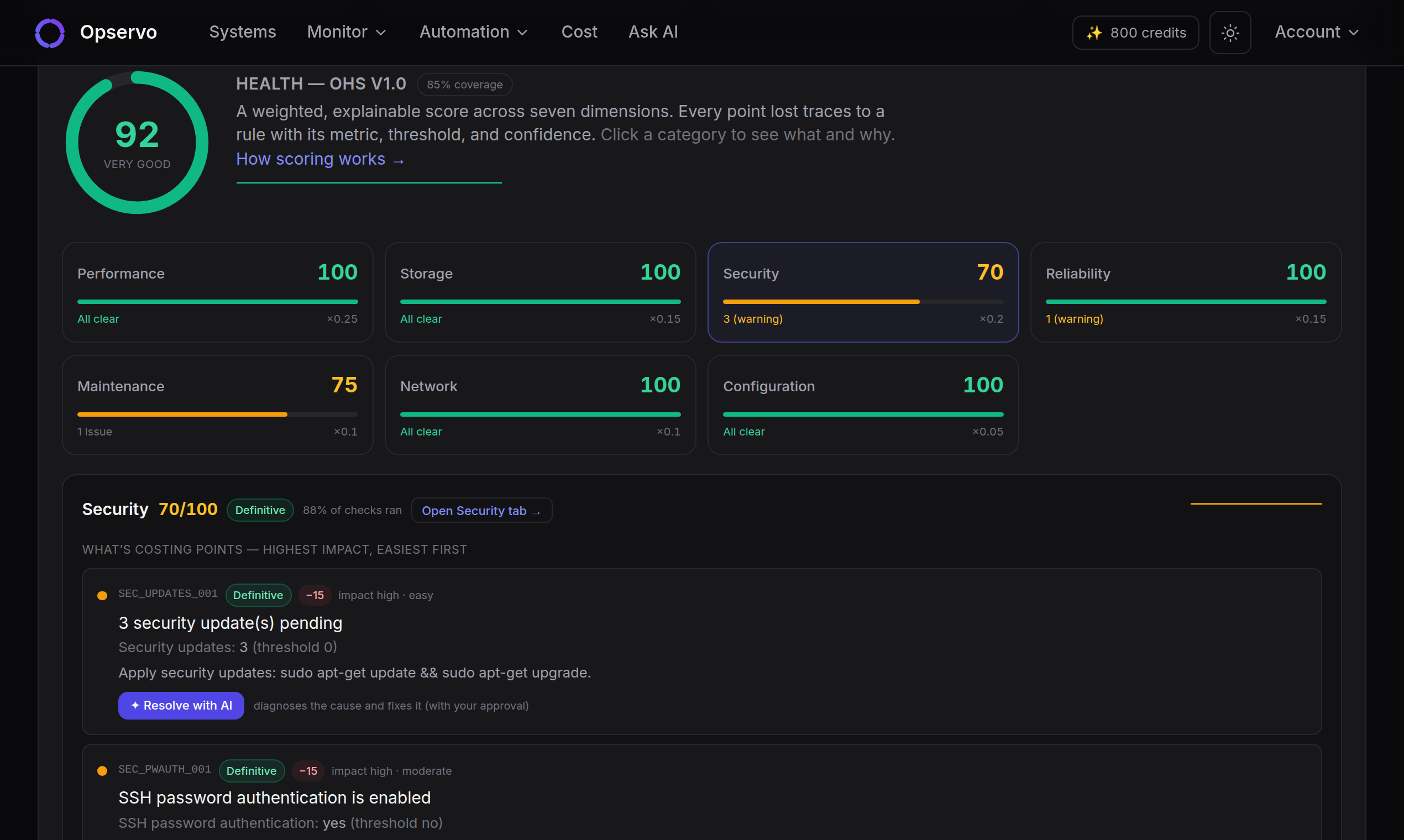
Every client server scored 0–100 across performance, security, storage, reliability, maintenance, network and configuration. Each lost point names the rule, the threshold, the current value and the fix, so Monday starts with the worst server, not the loudest alert.
Each client in its own workspace.
Multi-tenant workspaces keep every client’s servers, alerts, status pages and people apart. White-label means the client sees your brand, and the Agency plan includes SSO.
A number you can show the client.
A health score, a security score, a public status page and a “Monitored by” badge make the service you provide visible in the monthly review instead of invisible until something breaks.
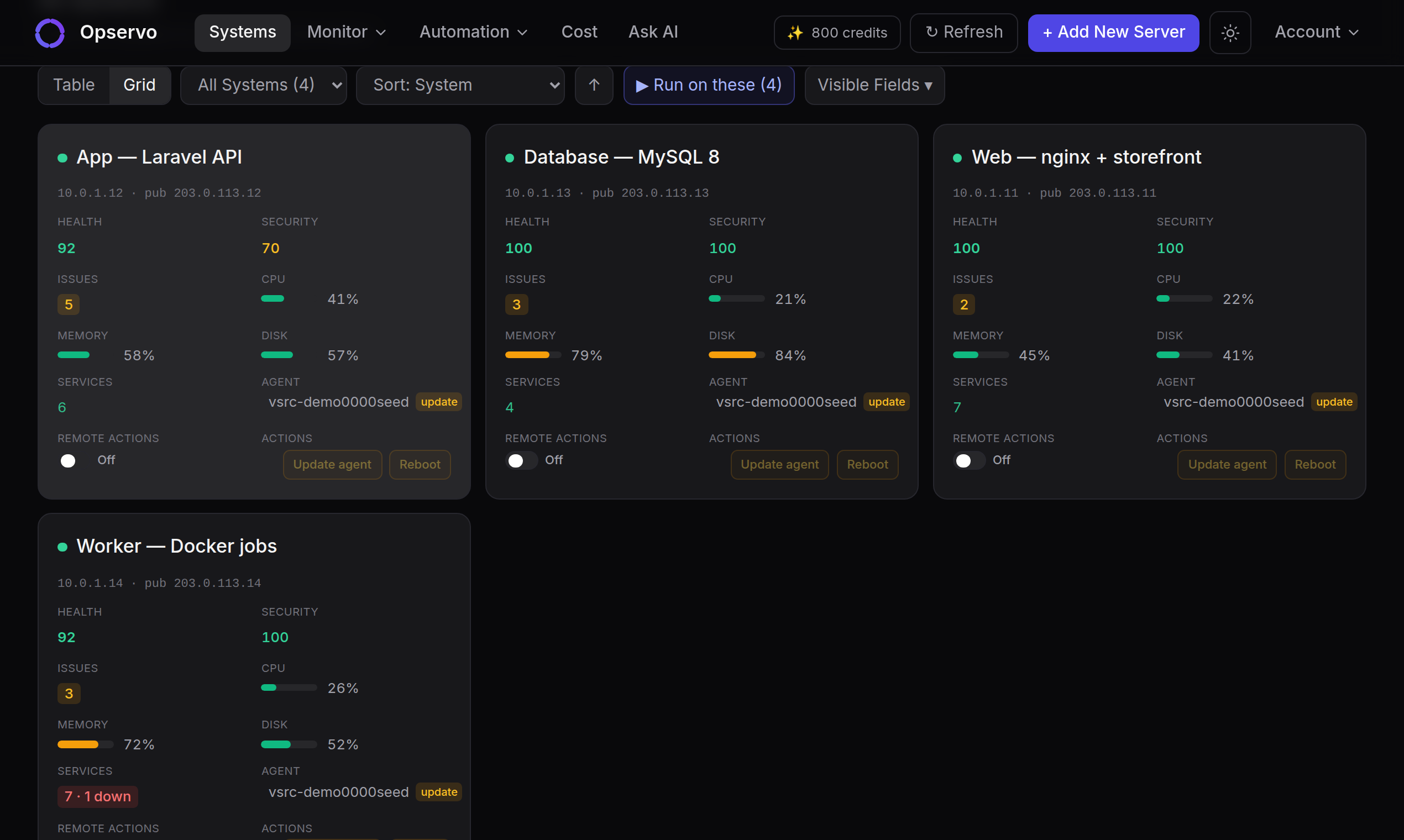
What the agent finds on a client server, with no configuration
systemd services, Docker containers, PM2 apps, nginx and Apache vhosts with their SSL expiry, open ports, MySQL, PostgreSQL and Redis, and Laravel, WordPress, Node, Django, FastAPI and PHP applications. Add external uptime checks, cron heartbeats, on-call rotations with SMS, WhatsApp and voice paging through your own Twilio, incident management and public status pages, in the same place.
Managing client fleets like Ansible? Tags, runbooks and fleet runs let you push one command or file to every server with a tag, with a dry run first. Hosting WordPress for clients? See how Opservo watches a WordPress server. Run an agency rather than an MSP? The agency page covers the same product from that side.
Safe on client servers
Read-only until you say otherwise.
- The agent is read-only by default and opens no inbound ports. It talks outbound over HTTPS, and every message is HMAC-signed.
- Agent updates and remote commands are Ed25519-signed.
- Remote actions and AI fixes are opt-in per server, and every one is audited. A fleet update never turns them on.
- Raw logs are never stored; Opservo keeps the clusters, not the lines.
- The agent never reads application .env files or secrets from disk.
Pricing for MSPs
Agency plan: ₹799 per server per month (about $9.50), 10-server minimum (₹7,990 a month, about $95), or ₹7,990 per server per year. Billed in INR. Includes multi-tenant workspaces, white-label, SSO and 250 AI credits per server. Start on the free plan with 2 servers and no card, and move the rest of the fleet over when it has earned it.
Where another tool fits better
- Windows desktops and endpoints: keep your RMM. Opservo watches Linux servers and Kubernetes clusters, not workstations.
- Datadog: if a client pays for an SRE who reads it every day, keep it there. Opservo runs beside it at a flat per-server price for the rest of the fleet.
- Uptime Kuma, UptimeRobot, Better Stack: they tell you a site is down. Opservo tells you why, and what to run.
Full comparisons, including where the other tools win: /compare
Put it on the client server that scared you last.
One command, about 30 seconds, first insight in under 5 minutes.
$ curl -sSL https://api.getopservo.com/install.sh | sudo bashQuestions: hello@getopservo.com