For Laravel teams
Laravel server monitoring for teams without an SRE
Your Laravel app is fine until the server under it isn’t. Install Opservo with one command, and about five minutes later it has found your Laravel apps, nginx vhosts, MySQL, Redis and SSL certificates. It scores the server from 0 to 100 and tells you in plain English what to fix first.
Free for 2 servers, no card. Read-only agent, no inbound ports.
What it finds on a Laravel server
Nothing to configure. No YAML, no exporters, no dashboards to build. The agent finds:
- Laravel apps, plus any WordPress, Node, Django or FastAPI apps on the same box
- nginx or Apache vhosts, and the SSL certificate behind each one, with its expiry date
- MySQL, PostgreSQL and Redis
- systemd services, Docker containers and PM2 processes
- Listening ports and running processes
The problems that actually page Laravel teams, explained
| What goes wrong | What Opservo tells you |
|---|---|
| Logs fill the disk | It forecasts when the disk will fill, names what is growing, and gives you the command to fix it. |
| Redis or MySQL stops | It tells you in one sentence which service stopped, when, and what the logs said just before. |
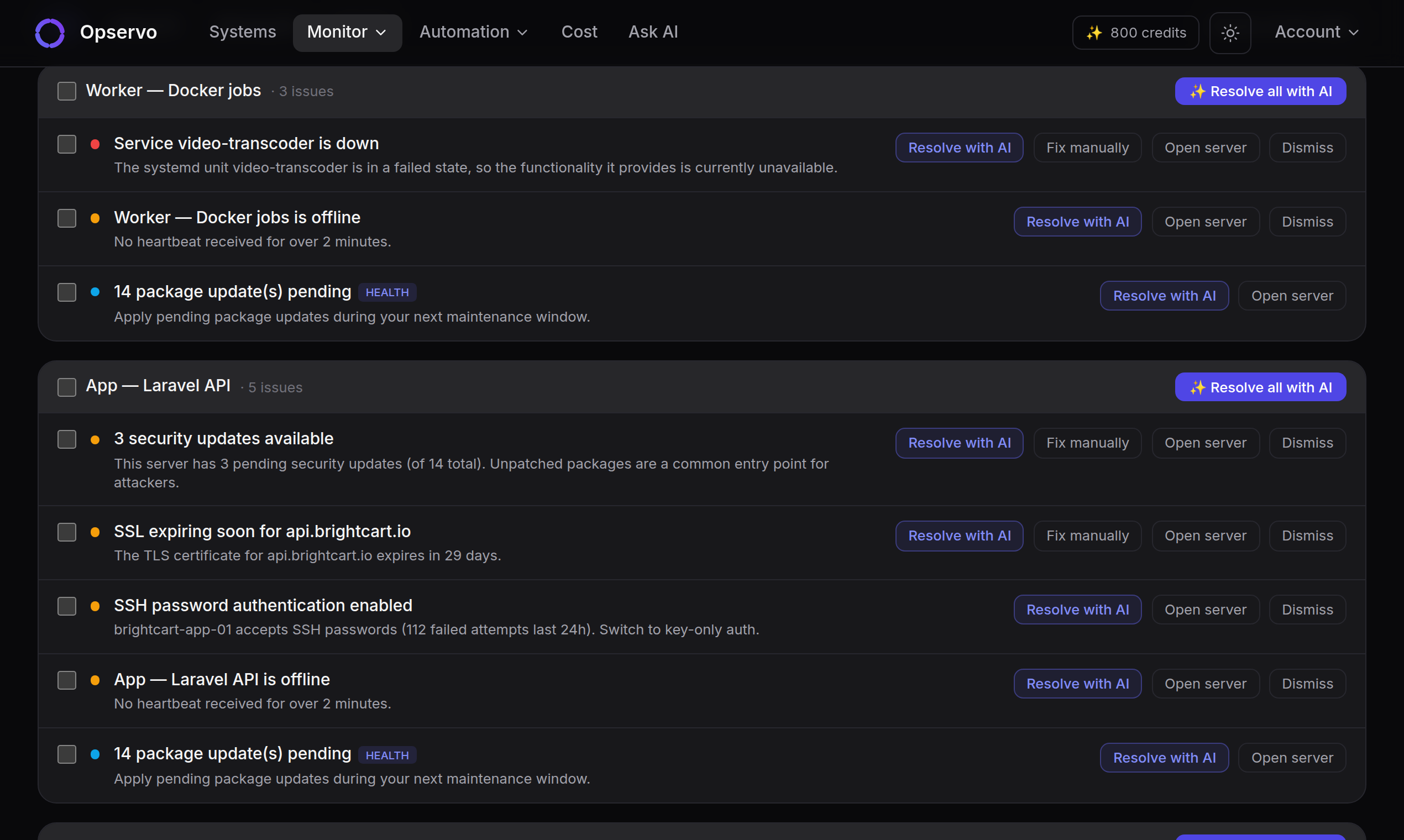
| An SSL certificate is about to expire | Every vhost’s certificate is found automatically and checked from outside, so you hear about it weeks ahead, not from a client. |
| Errors spike after a deploy | It correlates the metric spike with the log entries that explain it, and forecasts error spikes before they peak. |
| The server is slow and nobody knows why | Ask “why is this server slow?” The AI chat answers from the server’s live data and shows its sources. |
| The scheduler silently stops | Add a heartbeat URL to the cron line that runs your scheduler. If it stops checking in, you get paged. |
Every point explained
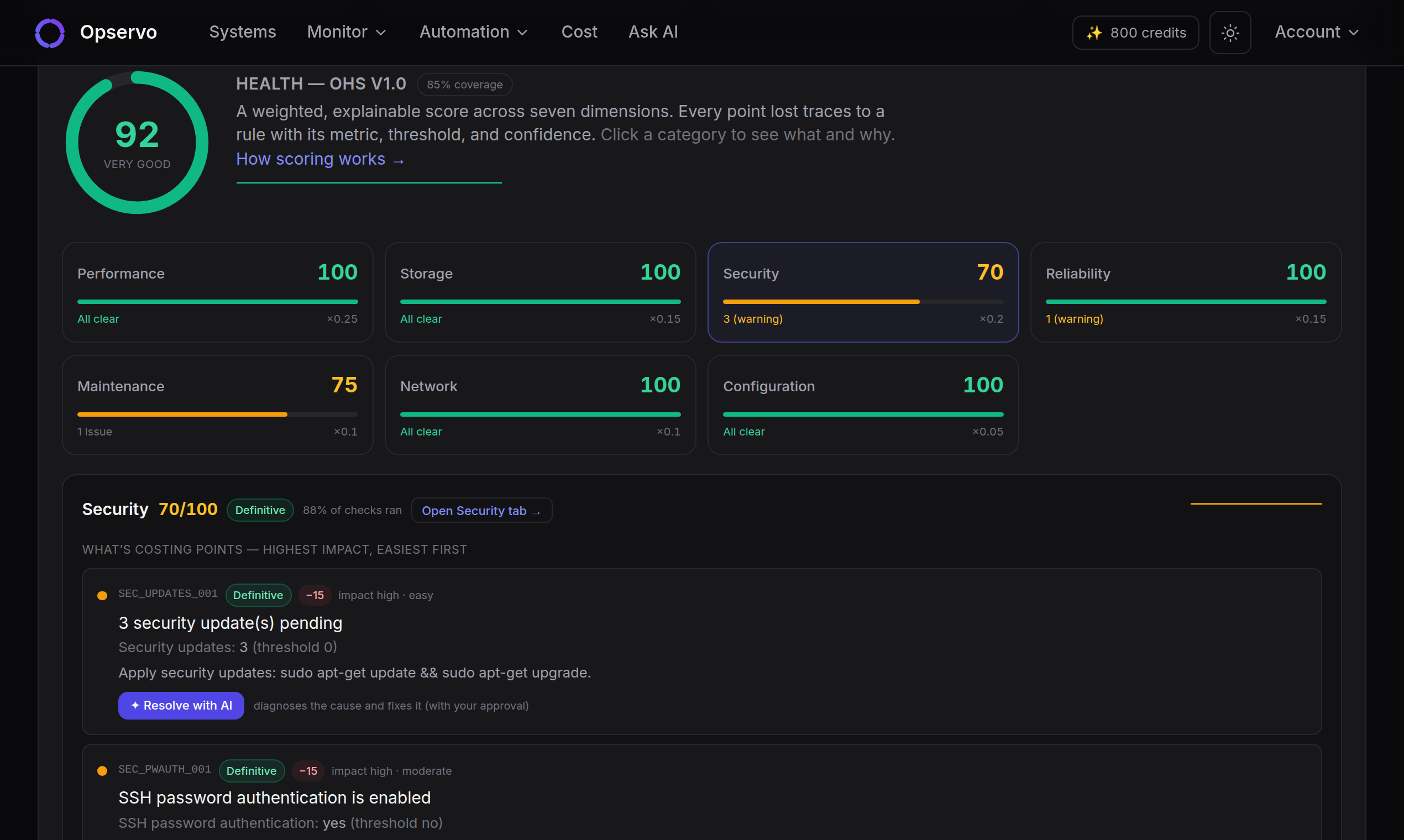
Each server gets a 0–100 score from the Opservo Health Standard across Performance, Security, Storage, Reliability, Maintenance, Network and Configuration. The score is deterministic, so the same server always gets the same score. Every lost point names the rule, the threshold, the current value and the fix. Sort the whole fleet by score and you know which server to look at first.
Fixes you approve, on servers you choose
When Opservo knows the fix, you apply it with one click or let a pre-approved policy do it. The agent is read-only by default and opens no inbound ports. It talks outbound over HTTPS with signed requests, and every update and remote command is signed too. Remote actions are switched on per server, every command and its output are audited, and a fleet update never switches them on for you.
Forge, a control panel, or by hand
Opservo runs on any Linux server, however it was provisioned. Forge provisions and deploys. Opservo watches what happens after the deploy: why it is slow, what changed, and the fix. Keep both. How Opservo and Forge fit together
A story from our own Redis
Softuvo runs 40+ production servers for 30 companies, many of them Laravel. From 31 July to 28 September this year, our own alert channel, a Discord webhook, rejected every alert with an HTTP 400. That included the alerts for an eight-day outage on one of our Redis servers. The monitoring caught the problem and the delivery threw the alert away. We fixed it, and every channel now records the result of its last delivery. We tell this story because silent alerts are exactly what we sell against.
What it is not
Opservo watches servers, not request traces. If you need per-request tracing inside your Laravel code, keep your APM and run Opservo beside it.
Questions
Do I need to change my Laravel code?+
No. The agent runs on the server and finds the app by itself. Nothing is added to your project.
Where does my data go?+
The agent sends metrics and findings out over HTTPS. Raw logs are never stored. AI answers come from Claude on AWS Bedrock, and you can bring your own key.
Where do alerts go?+
Slack (with /opservo commands), email, PagerDuty, OpsGenie or a custom webhook. On Growth you can also page people by SMS, WhatsApp or voice using your own Twilio account.
We host Laravel apps for many clients.+
The Agency plan keeps each client’s servers in their own workspace and can carry your brand. See Opservo for agencies at getopservo.com/for/agencies.
Hosting for clients? Opservo for agencies →
Install it on the Laravel server that scared you last.
About 30 seconds.
$ curl -sSL https://api.getopservo.com/install.sh | sudo bash