Why our server health score is not AI
Opservo uses AI to explain servers, not to score them. Why the 0–100 health score is a fixed standard, and why every lost point names its rule.
By Shanky Gupta
Opservo uses AI in a lot of places. It explains what is wrong with a server in plain English, clusters log lines into patterns, forecasts when a disk will fill, and answers questions in a chat grounded in live data from the server. One thing it deliberately does not use AI for is the health score.
The problem with a score you cannot question
Most monitoring tools that show a single "health" number do not tell you how they got it. If a server drops from 92 to 71 overnight, you are left guessing: was it the disk, the certificate, a service that restarted? A number you cannot question is a number you learn to ignore.
We run 40+ production servers at Softuvo, mostly looked after by developers doing ops on the side. For them, a score is only useful if it answers the next question on its own: what lost the points, and what do I do about it?
What the Opservo Health Standard does instead
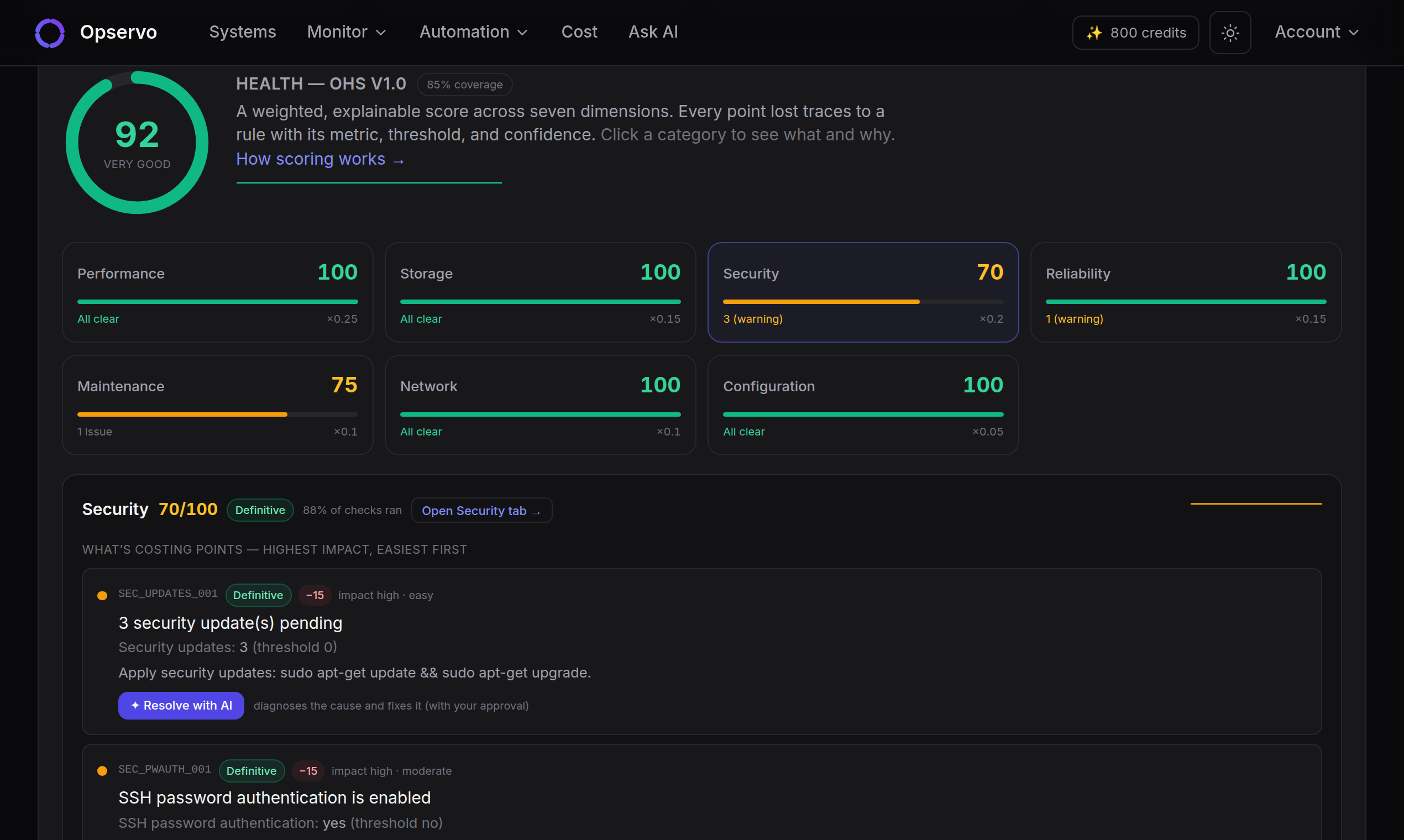
Every server gets a score from 0 to 100, built from seven areas: Performance, Security, Storage, Reliability, Maintenance, Network and Configuration. The score comes from a fixed set of rules, not a model. Two things follow from that:
- It is deterministic. The same server in the same state always gets the same score. Nothing about the score depends on how a model felt that day.
- Every lost point is explained. Each deduction names four things: the rule, the threshold, the current value, and the fix. If you disagree with a deduction, you know exactly what you are disagreeing with.
Where the AI comes in
The score tells you what. The AI helps with why and what next. When a server loses points, Opservo explains in plain English what changed and why it matters, and when the fix is known you can apply it with one click or a policy you approved in advance. The agent is read-only by default, and remote actions are opt-in per server and audited.
Keeping the two apart means the AI can be wrong in a sentence without making the score wrong. You can always fall back to the rule, the threshold and the value.
Three questions to ask of any health score
- Can it show you every point it took away? If not, you cannot tell a real problem from noise.
- Does the same state give the same number? If the score moves when nothing on the server changed, you will stop trusting it.
- Does each deduction come with a fix? A score that only grades you is a report card. A score that tells you what to do next is a to-do list.
Try it on your worst server
The full standard is public at getopservo.com/health-score. Opservo is the AI ops engineer for teams without an SRE: plain-English server monitoring with one-click fixes. Free for 2 servers. Start at getopservo.com/welcome.
Try Opservo free on 2 servers — one command installs a read-only agent and your first findings arrive in five minutes: start free.